
Occam's Razor
Prefer the explanation with fewer assumptions. A 700-year-old rule that doctors use to diagnose, detectives use to solve crimes, and physicists use to rewrite the universe - plus when it leads you catastrophically wrong.
Somewhere in fourteenth-century England, a Franciscan friar named William was working through a problem in logic when he wrote a sentence that would outlast his theology, his order, and the Latin language he wrote it in. Entities should not be multiplied beyond necessity. It was not an original thought - Aristotle had something like it - but William used it so sharply, so often, and so effectively that the principle now bears his name.
We call it Occam's Razor, and it is arguably the single most useful thinking tool ever named after a monk. The idea is deceptively simple: when you have several explanations that all account for the facts, the one that makes the fewest assumptions is probably right. A razor, because it cuts away the unnecessary. What remains, after the shave, is usually closer to the truth.
But here is what almost every pop-science article gets wrong about Occam's Razor: it is not a law. It is not even quite a rule. It is a heuristic - a bias toward simplicity that tends to pay off over many decisions but that can, and sometimes does, lead you straight off a cliff. Understanding both sides of that coin is what this essay is about.
The monk and the razor
William of Ockham - the village he came from in Surrey, England, spelled two different ways depending on the century - was born around 1287 and died around 1347, most likely of the Black Death. He was a Franciscan friar, a logician, and something of a troublemaker. He spent years under house arrest in Avignon after being accused of heresy, escaped to Munich, and wrote furious pamphlets against the Pope. He was, in other words, exactly the kind of person who would develop a tool for cutting through nonsense.
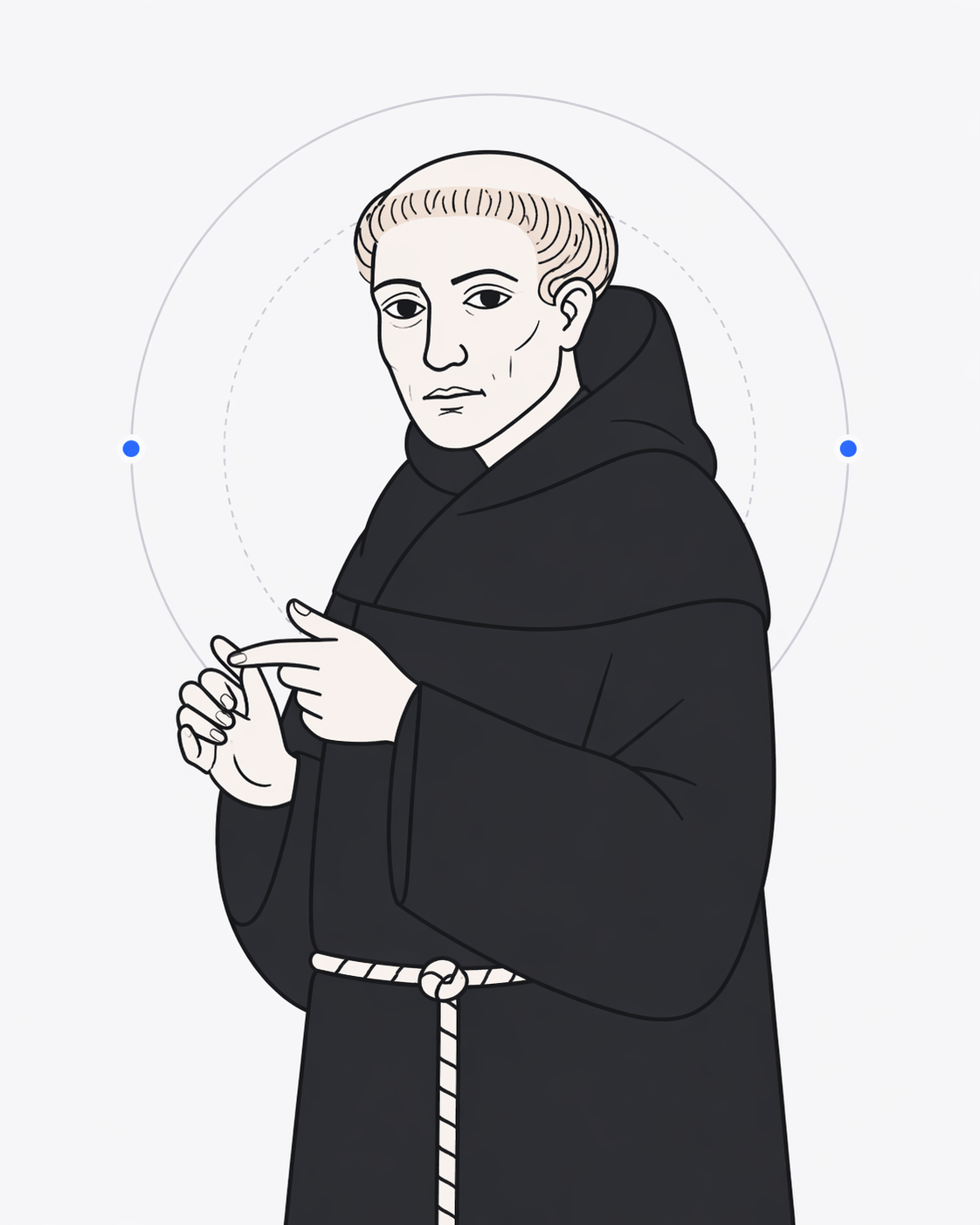
His actual formulations of the principle - he wrote several variations - were in Latin, and they are more interesting than the pop versions suggest:
Pluralitas non est ponenda sine necessitate.
Plurality must never be posited without necessity
Notice what William did not write "the simplest explanation is always correct." He did not even write that simple explanations are more likely to be true. He wrote something subtler: do not invent entities, causes, or assumptions that you do not need. If you can explain a phenomenon with three things, do not invent a fourth. The fourth is not forbidden; it is just on probation until it earns its place.
The metaphor of the "razor" came later - not from William at all, but from writers in the sixteen- and seventeen-hundreds who liked the image of the principle shaving away unneeded assumptions. By the time Isaac Newton restated it in the Principia as his first Rule of Reasoning - "we are to admit no more causes of natural things than such as are both true and sufficient to explain their appearances" - the razor was already a fixture of Western thought.
What the razor actually says
Strip away the Latin and the folklore, and the razor reduces to a single claim: between two explanations that fit the evidence equally well, prefer the one with fewer moving parts.
The phrase "fit the evidence equally well" is doing enormous work in that sentence. The razor does not say to prefer simple explanations over complex ones in general. If a complex explanation fits the facts better than a simple one, the complex explanation wins - every time, without exception. The razor only activates when two explanations are tied on the evidence. It is a tiebreaker.
Let's make this concrete. You come home and find your front door open. You did not leave it open. You can generate an enormous list of hypotheses: (a) you forgot to close it; (b) someone in your household opened it; (c) the wind pushed it; (d) a burglar broke in; (e) a government agency entered to install surveillance; (f) a poltergeist; (g) a raccoon learned to work door handles.
All of these "explain" the open door. The razor does not tell you to pick (a) just because it's the simplest - it tells you that, absent any other evidence, (e) and (f) require you to assume the existence of things (secret agencies targeting you, poltergeists) that you have no independent reason to believe exist. Each of those is a "multiplied entity." They are on probation. If you later find a black van on your street, (e) may graduate off probation. Until then, the razor tells you to bet on (a), (b), or (c).
The razor is not a law of nature. It is a bet on the structure of explanation itself - a wager that reality, on average, is less ornate than the stories we tell about it.
Science: Copernicus, Einstein & the universe that preferred simple
Science is where the razor has its most spectacular wins, and it starts with a sixteenth-century Polish astronomer who was tired of doing math.
Copernicus vs. Ptolemy
For over a thousand years, the accepted model of the cosmos was Ptolemy's: Earth sat at the center, and the Sun, Moon, planets, and stars all revolved around it. The problem was that the planets, when you actually watched them, did not move in tidy circles. They sped up, slowed down, and even appeared to reverse direction - a phenomenon called retrograde motion. To save the geocentric model, Ptolemy's successors added "epicycles": little circles within circles. When epicycles weren't enough, they added epicycles on top of epicycles.
Copernicus published De revolutionibus in 1543 with a radical alternative: put the Sun at the center instead. The math suddenly got simpler. Retrograde motion turned out to be an optical illusion caused by Earth overtaking slower outer planets on its faster inner orbit. Dozens of epicycles collapsed into a handful of elegant ellipses.
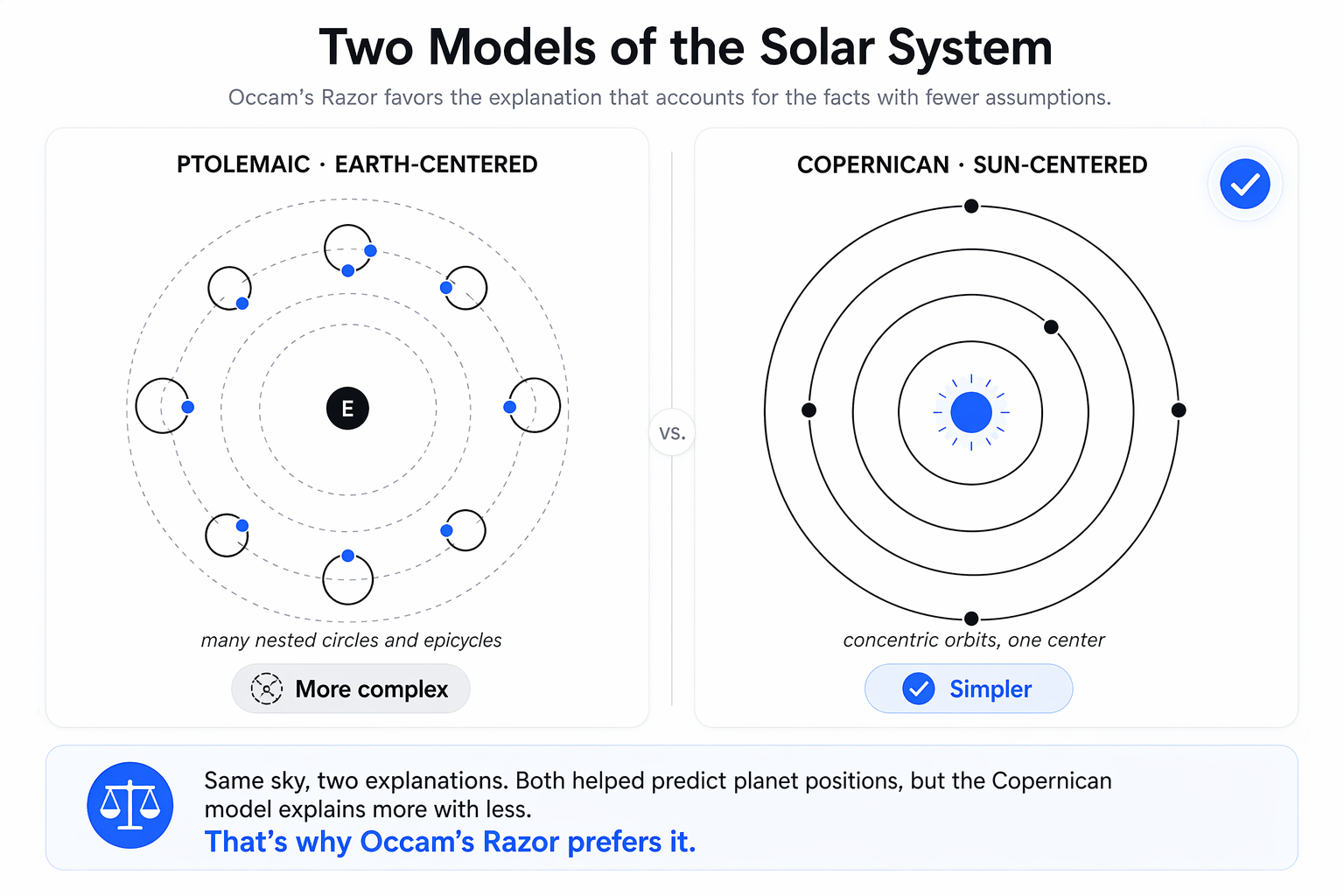
Notably, early Copernicanism was not actually more accurate than late-stage Ptolemaic astronomy - both produced roughly comparable predictions of planet positions. But Copernicus's model was dramatically simpler. Occam's Razor told working astronomers, decades before Galileo's telescope provided harder evidence, to bet on the Sun.
Einstein and the luminiferous ether
By the late 1800s, physicists had convinced themselves that light, being a wave, must travel through some medium - just as water waves need water. They called this medium the "luminiferous ether" and assumed it filled all of space. The Michelson–Morley experiment in 1887 tried to detect Earth's motion through the ether and found, to everyone's shock, nothing.
For nearly twenty years, physicists added epicycles - metaphorical ones this time. Perhaps the ether was dragged along with the Earth. Perhaps objects moving through it contracted in the direction of motion. Each patch kept the ether alive at the cost of making it weirder.
Then in 1905, a 26-year-old patent clerk named Einstein published his special theory of relativity, which accounted for every known observation - including Michelson–Morley - without any ether at all. Light just travels at the same speed in every reference frame. No medium required. Einstein did not prove the ether did not exist; he showed it was unnecessary. The razor did the rest, and within a generation the ether vanished from physics entirely.
The limits: string theory
Modern physics also provides a cautionary tale. String theory proposes that fundamental particles are tiny vibrating strings rather than points. It is mathematically beautiful and offers a possible unification of quantum mechanics with gravity. It also requires somewhere between ten and twenty-six spatial dimensions, none of which we have ever observed. By Occam's standards, this is an enormous multiplication of entities. Some physicists defend it anyway, arguing the mathematical elegance justifies the ontological extravagance. The jury is still out - which is exactly where the razor leaves us when evidence is genuinely ambiguous.
Medicine: the hoofbeats rule
There is a saying taught in medical schools around the world: "When you hear hoofbeats, think horses, not zebras." It is Occam's Razor in stethoscope form. When a patient presents with a headache, fatigue, and a sore throat, the overwhelming statistical likelihood is a common viral infection, not a rare tropical parasite. Doctors are explicitly trained to pursue the simplest, most common explanation first.
This matters clinically for at least three reasons. First, pursuing rare diagnoses first is expensive - MRIs, specialist consults, biopsies - and those costs are not just financial: every test has false-positive rates and side effects. Second, patients often have one thing wrong with them, not several. If a set of symptoms can all be explained by one underlying condition (a "unifying diagnosis"), that is usually the right answer. Third, common things happen commonly, and probability matters more in medicine than in almost any other field.
The patient with everything
A 55-year-old man comes in with fatigue, shortness of breath, swollen ankles, and recent weight gain. You could hypothesize: anemia (fatigue), asthma (shortness of breath), a venous problem (swollen ankles), and depression (weight gain) - four separate diagnoses requiring four separate workups.
Or you could apply the razor: all four symptoms are classic presentations of congestive heart failure. One diagnosis, one cause, one treatment plan. A good clinician reaches for the unifying explanation first and only expands the differential when the simple answer fails to fit.
But medicine also gives us the razor's most important counterexample, enshrined in another piece of medical wisdom: "Hickam's dictum." Named after a twentieth-century American physician, John Hickam, it reads: "A patient can have as many diseases as he damn well pleases." Old patients in particular - who have accumulated decades of wear and multiple chronic conditions - frequently violate the razor. A 78-year-old with fatigue may have anemia and heart failure and depression. Assuming a unifying diagnosis here will miss two-thirds of what is wrong with her.
The razor works best when the priors are simple. In medicine, this means young, otherwise-healthy patients. The older and more complex the patient, the less the razor can be trusted alone.
Detective work: from Holmes to crime labs
Sherlock Holmes is often, and wrongly, cited as the patron saint of Occam's Razor. His famous line - "when you have eliminated the impossible, whatever remains, however improbable, must be the truth" - is actually the opposite of the razor. Holmes is saying: don't be afraid of baroque, unlikely explanations if the evidence forces you there. The razor says: don't reach for baroque explanations when the evidence doesn't require them.
Real detective work uses both. The razor dominates early in an investigation, when you're generating hypotheses. Spouses commit more murders than assassins. Robberies happen more often than elaborate staged frame-ups. When a wallet is missing, the simplest explanation (theft or loss) beats the complex one (a conspiracy to make you think it was stolen) - unless evidence specifically points to the conspiracy.
The razor in the crime lab
Forensic scientists routinely invoke the "principle of parsimony" when reconstructing crime scenes. If blood-spatter patterns, fingerprint positions, and entry-point damage are all consistent with a single assailant, investigators do not posit two assailants without additional evidence.
This is why prosecutors prefer simple narratives to juries and defense attorneys often try to complicate them. Juries, like the razor, instinctively reach for the simplest story that accounts for the evidence.
There is also a dark flip side. The razor can produce what criminologists call "premature closure" - investigators latch onto a simple, compelling theory and stop looking. The wrongful conviction literature is full of cases where the obvious suspect turned out to be innocent, and investigators' confidence in the simple story delayed the discovery of the real perpetrator by years or decades. Occam's Razor tells you where to start. It does not tell you when to stop.
Business and product design
In business, the razor shows up disguised as a series of slogans: "keep it simple," "less is more," Apple's famous "it just works," the engineering acronym KISS. But the underlying principle is the same - every added feature, process, dependency, or explanation is an entity that must justify its existence.
Product design
The original iPhone, launched in 2007, had one physical button on its face. Its competitors had keyboards with thirty or forty. Steve Jobs's obsession with reducing feature count was a near-fanatical application of the razor: if the function was not essential, it was cut. Every removed button was an entity not multiplied beyond necessity. The gamble - that users would prefer fewer, more general-purpose interactions - paid off spectacularly.
The same principle underlies Google's original homepage (a search box, a logo, and nothing else, against a sea of portal sites crammed with news and horoscopes), the Dieter Rams design philosophy that inspired decades of Braun and Apple products, and the entire "minimalist" aesthetic movement in software.
Strategy and organizations
When a business underperforms, executives often invent elaborate explanations: market conditions, macroeconomic headwinds, disruptive competition. Sometimes these are real. Often, the razor-sharp explanation is simpler and less flattering: the product isn't good enough, or the price is wrong, or the sales team is underperforming. Simple diagnoses are unpopular because they imply simple, often uncomfortable, actions.
Where business misapplies it
"Simple" is not the same as "easy." Reducing a feature set is not always better - sometimes the complex feature was doing real work for a niche of power users. Simplifying an org chart is not always better - sometimes the "unnecessary" layer was handling coordination that now gets dropped on the floor. The razor, properly applied, says: remove what you don't need. It does not say: remove things until you feel minimalist.
Everyday reasoning
Most of the places you'll actually use Occam's Razor are far less dramatic than cosmology or cancer diagnosis. They are the micro-decisions of daily life, where the razor functions as a quiet defense against paranoia, overthinking, and conspiracy.
Related Razor
Hanlon's Razor: "Never attribute to malice that which is adequately explained by stupidity." A specialized application of Occam's Razor to human behavior - malice requires a planner, a motive, and usually a conspiracy, all of which need evidence. The razor almost always favors the mundane explanation of human behavior, and almost always, it is right.
When the razor cuts the wrong way
For all its virtues, Occam's Razor has a famously bad track record in certain domains, and understanding them is as important as understanding its applications.
Biology: evolution is a tinkerer
The human eye has a blind spot because the optic nerve attaches in front of the retina rather than behind it. This is a bizarre, inelegant arrangement - no engineer would design it. The octopus eye, evolved independently, gets it right: the nerve attaches behind the retina, and there is no blind spot. A razor-wielding biologist, shown only the human eye, would predict the octopus design exists because it is simpler and better. But evolution does not optimize for simplicity. It works with whatever mutation happens to increase fitness from the existing configuration, and the results are often grotesquely complex.
Biology is full of such Rube Goldberg contraptions: the recurrent laryngeal nerve that loops unnecessarily around the aorta, the human knee, the vertebrate retina, the appendix. The razor consistently underestimates how messy evolved systems can be.
Quantum mechanics: reality is weird
If you had shown a classical physicist in 1900 the predictions of quantum mechanics - particles that exist as probability clouds, that are both waves and particles, that appear to communicate instantaneously across distances - they would have raised their razor and dismissed it as absurd. The theory multiplies entities with abandon. And yet it is, by orders of magnitude, the most experimentally confirmed theory in the history of science. Reality, at small scales, is baroque beyond the razor's imagination.
History and human affairs
Historians often caution against what they call monocausal explanations. Why did Rome fall? A razor-wielding amateur might confidently assign it to one cause - Christianity, lead poisoning, barbarian invasions, economic collapse. Professional historians almost always say: all of these, and more, interacting over centuries. Complex historical events usually have complex causes, and the search for a single clean story is often a search for a lie you can feel good about.
Conspiracies that are real
Real conspiracies do exist. Watergate was a conspiracy. The tobacco industry's decades-long campaign to conceal the link between smoking and cancer was a conspiracy. The razor tells you to bet against conspiracies when you have no evidence - but when evidence accumulates, the razor starts to favor the conspiratorial explanation, because the "no conspiracy" explanation now requires its own growing pile of assumptions.
Simplicity is not always truth. Sometimes it is just a failure of imagination dressed up as rigor.
How to actually use it
If you take only one thing from this essay, take this: Occam's Razor is a tool, and tools have contexts where they work and contexts where they don't. Using it well requires a small discipline.
First, check that your candidate explanations actually fit the evidence. The razor only operates on surviving hypotheses. A simpler explanation that fails to account for the facts loses to a more complex one that does, every time.
Second, count assumptions, not words. "God did it" is three words, but it assumes the existence of God, the motive of God, and the mechanism of God - three enormous unsupported entities. Simplicity is about the ontology of the explanation, not its syntax. What does this theory require me to believe that I didn't already believe? Count those.
Third, ask whether you're in a domain where the razor historically works. Physics and engineering: yes, usually. Simple mechanical diagnosis, everyday human behavior: yes. Evolutionary biology, geopolitics, quantum mechanics: proceed carefully. The razor is not a universal solvent; it is a heuristic tuned to certain kinds of problems.
Fourth, hold your simple explanation loosely. The razor tells you where to bet, not what to believe with certainty. When new evidence arrives, let it update you. Simple explanations can and do lose to complex ones, and the rational response is to switch horses, not to defend the stable.
The principle, restated
Among explanations that fit the evidence equally well, prefer the one making the fewest unsupported assumptions - but remember that this is a starting bet, not a final verdict, and the world is sometimes stranger than your preferences.
Seven hundred years ago, William of Ockham was trying to cut through a jungle of medieval theology in which philosophers were inventing invisible entities the way later centuries would invent ether and epicycles. He wanted to make thinking cleaner. The instrument he named - a razor - is still working. Doctors use it every day. Physicists still wield it against baroque theories. Software engineers invoke it when they trim features. You use it, almost without noticing, every time you decide your spouse probably isn't angry at you, just tired.
It is, like all the best thinking tools, simple. Almost insultingly simple. Which is, of course, the point.