
Inversion
Solve problems backwards. Instead of asking how to succeed, ask how to fail — and then don't do that. A 200-year-old thinking tool that mathematicians, Stoics, and the world's best investors swear by.
In the early 1800s, a German-born mathematician named Carl Gustav Jacob Jacobi was teaching at the University of Königsberg when he began ending his lectures on tough problems with a single, famous instruction: man muss immer umkehren — "one must always invert." When a problem resisted a direct attack, Jacobi said, flip it. Don't ask what makes this true. Ask what would make it false. Don't ask how to solve it. Ask what the solution would have to avoid.
Jacobi's students found this infuriating at first, then useful, then indispensable. Two centuries later, Charlie Munger — the vice chairman of Berkshire Hathaway and Warren Buffett's longtime partner — built an entire investment philosophy on the same three words. "Invert, always invert," he said, quoting Jacobi at nearly every Berkshire annual meeting for forty years. "All I want to know is where I'm going to die, so I'll never go there."
That's inversion. It's not a clever trick. It's a discipline — a systematic habit of approaching every hard problem from the opposite direction as well as the forward one. And it works because human minds are catastrophically bad at forward-only thinking. We see what we want; we don't see what we need to avoid. We plan for success; we don't plan against failure. Inversion closes that gap.
This essay is about how to use it.
What inversion actually is
Strip it down to one line: inversion is the practice of solving a problem by first asking its opposite. Instead of "how do I achieve X?", you ask "what would guarantee I fail to achieve X?" — and then you design your approach to avoid those things.
It sounds almost too simple to be useful. Of course you should avoid the things that cause failure. But here's what's strange: almost nobody does this systematically. Forward thinking — listing the things you need to do — is our default. Inverse thinking — listing the things that would kill you — feels negative, pessimistic, unproductive. So we skip it. And then, predictably, we get killed by the things on the list we never wrote.
Jacobi himself used inversion in pure mathematics. Rather than try to prove a difficult theorem directly, he'd often prove its contrapositive — the logically equivalent reversed statement — which turned out to be easier to attack. Munger took the same instinct out of the seminar room and applied it to business, investing, and life. The most useful thing inversion does, in his hands, is this: it forces you to confront failure before it happens, when the confrontation is still cheap.
Why forward thinking systematically fails
Human cognition is built for pattern-matching, goal-seeking, and storytelling. All three are forward-biased. When you set a goal, your mind races ahead to imagine success — the office you'll occupy, the profit you'll make, the relationship as it flourishes. This isn't a bug; it's how motivation works. But it has a brutal side effect: you become blind to what could go wrong, because your attention is locked onto what could go right.
Psychologists have a name for this — motivated reasoning. You're more critical of evidence that threatens your plan than of evidence that supports it. You notice arguments for proceeding; you underweight arguments for caution. And when you do think about risks, you tend to list the ones you've already handled, which is a kind of self-congratulation rather than a genuine stress test.
The failure mode
Forward-only thinking produces plans that look great on paper and fall apart on contact with reality — because the plan was built against imagined success, not against actual hazards. The hazards weren't hidden. You just never asked the question that would have revealed them.
Inversion is the corrective. By explicitly asking "what would make this fail?", you conscript your pattern-matching machinery into the service of skepticism. You're no longer trying to justify the plan — you're trying to break it. And because the human mind is just as good at imagining disaster as it is at imagining success, once you point it in that direction, it does excellent work.
Investing: Munger's rule
Charlie Munger's investing philosophy, distilled, is surprisingly simple. He doesn't spend most of his time trying to identify great investments. He spends most of his time trying to identify how investments go wrong — and then avoids those situations. The remaining opportunities, he figures, will mostly take care of themselves.
It is remarkable how much long-term advantage people like us have gotten by trying to be consistently not stupid, instead of trying to be very intelligent.
— Charlie MungerThis is inversion at industrial scale. Munger maintained, and frequently described in public, a mental list of behaviors and situations that reliably destroy capital: leveraging to buy illiquid assets, falling for businesses you don't understand, ignoring incentive structures, trusting accounting earnings without examining cash flows, investing with bad people. Avoid all of these, he argued, and you've done 80% of the work of being a successful investor. The remaining 20% — actually picking winners — is far easier once the disaster zones are fenced off.
How Berkshire avoided the 2008 financial crisis
In the mid-2000s, Berkshire Hathaway held essentially no major positions in investment banks, mortgage originators, or complex structured-credit products — the exact assets that collapsed catastrophically in 2008. This wasn't because Buffett and Munger had foreseen the crisis in detail. It was because they had inverted: what kinds of businesses blow up spectacularly? Ones whose earnings depend on leverage, on short-term funding, on financial instruments management can't fully explain. Those businesses went on the "never" list years before the crisis arrived.
The reward for inversion isn't knowing the future. It's being absent from the places where the future turns out to be very bad.
Engineering, safety & design
Engineering has inversion baked into its professional DNA, though engineers rarely call it that. They call it failure analysis, fault tree analysis, or FMEA (Failure Modes and Effects Analysis) — but the core move is identical to Jacobi's. Before you build a bridge, a plane, or a nuclear reactor, you systematically enumerate every way it could fail, how likely each failure is, and how severe the consequences would be. Then you design backwards from that list.
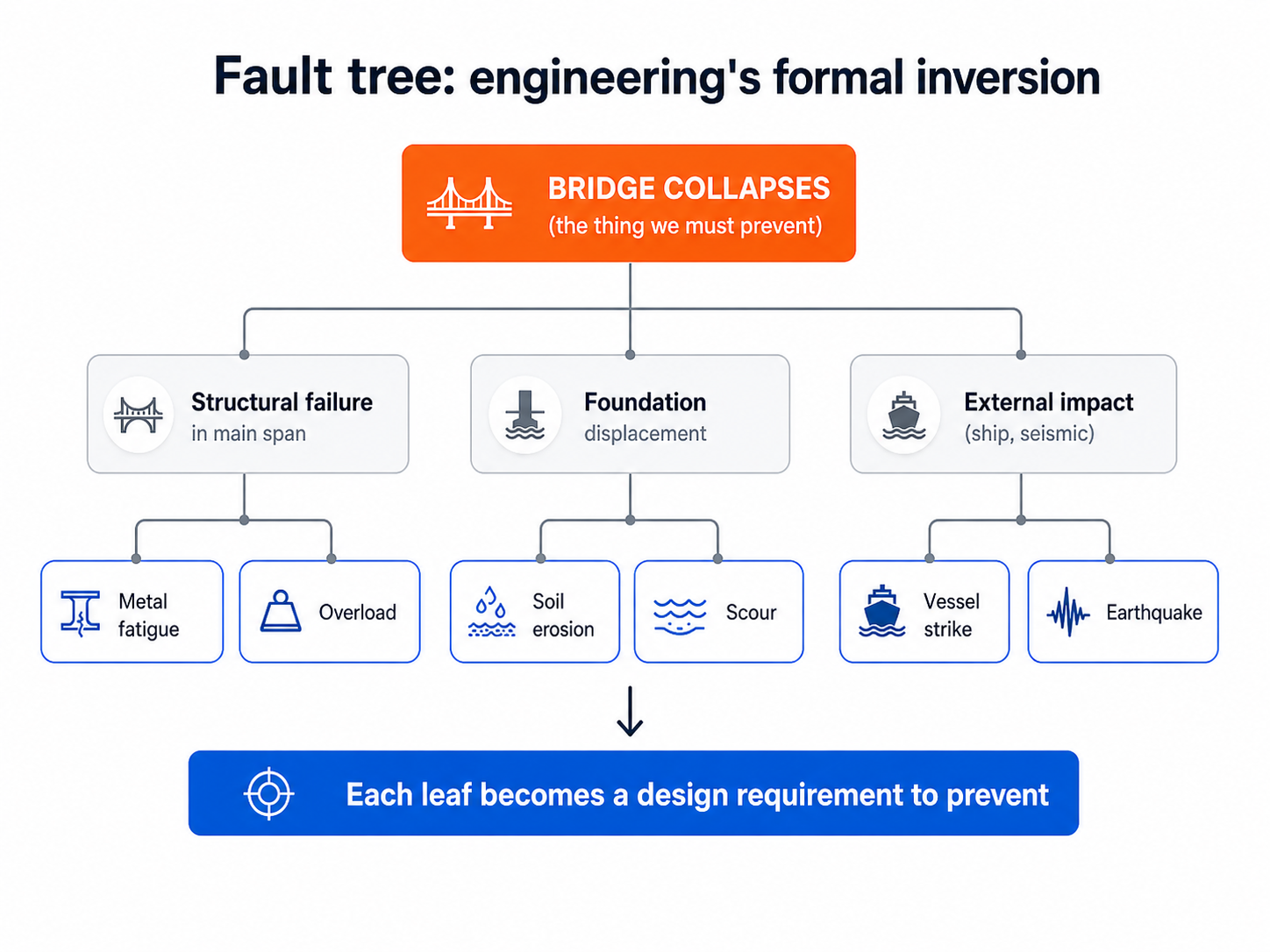
NASA's pre-launch checklists, the FAA's aircraft certification processes, medical device regulation, nuclear plant operations — all are institutional applications of inversion at enormous scale. The question driving these systems is never "what would make this work?" It is always "what could make this kill people?" — followed by: "and what would prevent that?" The forward question is too easy. It has a million answers. The inverted question is harder, narrower, and produces genuinely useful engineering.
Security engineering is another domain where inversion is the entire job. A security professional is someone paid to think like an attacker — to find the ways a system could be compromised, precisely because the developers who built it were thinking forward (making it work) and could not simultaneously think backward (how it could be broken). "Red teams" exist to professionalize inversion. Their brief is: break this. The builders can't do it themselves, because their minds are in the wrong orientation.
The Stoics: premeditatio malorum
Inversion didn't start with Jacobi. It's at least as old as the Stoic philosophers of ancient Greece and Rome, who practiced a discipline they called premeditatio malorum — "the premeditation of evils."
Premeditatio malorum.
The premeditation of evils
Seneca, writing to his friend Lucilius in the first century, advised him to begin each morning by imagining everything that could go wrong that day: the carriage might break down, the friend might betray him, the child might fall ill, the plan might fail. Not to dwell on these things morbidly, but to rob them of their ability to shock. A calamity expected is a calamity halved — because half of suffering is surprise.
This is inversion applied to emotional resilience rather than decision-making. Forward-thinking people, the Stoics observed, walk through life assuming smoothness. When disruption arrives, they are blindsided; they grieve not only the loss but the violation of their expectation. The Stoic practice of premeditation inverts this. By regularly contemplating the worst, you build a psychological buffer. You're not pessimistic — you're calibrated. You're still aiming for the good outcome; you're simply unsurprised when the bad one arrives.
Modern cognitive behavioral therapy uses a version of this under the name "decatastrophizing," and there's good evidence it reduces anxiety. It works for the same reason engineering fault trees work: imagined disasters are less potent than unimagined ones. Rehearsal is protection.
Business and product
Business is full of forward thinkers — strategy decks full of growth targets, roadmaps full of features, pitches full of optimistic numbers. Business benefits enormously when someone inverts.
Forward question
How do we build a product people love?
Produces feature lists, user research plans, roadmap priorities. All useful, but often generates bloat — teams shipping many things, hoping some of them resonate.
Inverted question
What would make users hate this product?
Produces a much shorter, clearer list: slow load times, confusing flows, broken promises, hidden fees. Fix those first, and you've done most of what "lovable" actually requires.
Product designers at the best companies do both questions, in that order. The inverted question surfaces the real constraints. The forward question then fills in the opportunities on a foundation that isn't actively driving users away. This is the ordering Amazon used for years under Jeff Bezos's "working backwards" discipline — writing the press release and FAQ for a product before building it, to surface the ways it could fail to matter before committing engineering time.
Marketing and positioning
Good marketers invert constantly. "How do we make our product sound attractive?" is a bad question — it produces jargon and hype. "What would make this feel untrustworthy?" is a much better one — it produces the list of things to never do: overclaiming, vague proof, manipulative scarcity, hidden terms. Avoid all of those, and what remains often sounds good almost by default.
Hiring
"Who are the great candidates?" is a question that almost never works in interviews, because great performers can fail interviews and mediocre ones can ace them. "What would a bad hire look like, and how would we know?" is sharper. It produces concrete signals to watch for: inability to explain past decisions, inconsistent stories, defensive reactions to hard questions, history of blaming others. Hiring for the absence of these is more reliable than hiring for the presence of charisma.
Relationships and everyday life
Inversion generalizes beyond professional domains into ordinary decisions, and it's often where it does its most useful work — precisely because daily life is where we're least likely to stop and think carefully.
Relationship research bears this out with unusual clarity. The psychologist John Gottman famously found that predicting whether a marriage will last is far easier than predicting whether it will be happy — and the best predictors are negative behaviors, not positive ones. His "Four Horsemen" — criticism, contempt, defensiveness, and stonewalling — are a checklist of things to eliminate. A marriage that successfully avoids all four does not automatically become joyful, but a marriage that contains them almost never survives. The forward question ("how do I make my marriage great?") is hard and vague. The inverted question ("what would guarantee this ends badly?") is actionable and specific.
The same pattern repeats across most life domains. If you want to be healthy, the list of foods to eat is contested and confusing; the list to avoid (ultraprocessed, excess alcohol, trans fats) is much clearer and more universally agreed upon. If you want a good career, the list of jobs to pursue is bewildering; the list to avoid (toxic bosses, stagnant roles, industries in secular decline) is much shorter. Again and again, the "don't" list is more useful than the "do" list — not because doing doesn't matter, but because avoiding sets the floor, and the floor is where most outcomes are actually determined.
Tell me where I'm going to die, so I'll never go there.
— Charlie Munger, on why he invested by inversionThe premortem: inversion as a meeting
One of the most useful operational applications of inversion is a technique the psychologist Gary Klein calls the premortem. It's a simple exercise any team can run before committing to a major decision.
The usual way teams assess a plan is to ask: "does this look like a good idea?" Around a conference table, this almost always produces agreement — partly because the people proposing the plan are present, partly because dissent feels disloyal, partly because the plan sounds reasonable when described by its advocates. Real risks go unspoken, and the team commits with false confidence.
The premortem inverts this. Instead of asking whether the plan will work, the facilitator says: "Imagine it's a year from now. This project has failed disastrously. Write down, individually and in detail, why it failed." The team spends fifteen or twenty minutes writing, then shares. What emerges is extraordinary: all the risks people had quietly noticed but not voiced — the technical limitation, the cultural clash, the regulatory exposure, the missing hire — suddenly appear, because the exercise has given permission to imagine failure without seeming disloyal.
Running a 30-minute premortem
Minutes 0–5: Frame the exercise. "Pretend we're one year from today. This project has failed. Why?"
Minutes 5–15: Silent individual writing. Each person lists as many reasons for failure as they can think of. No discussion yet — this prevents early contributions from anchoring everyone else.
Minutes 15–25: Go around the table, each person sharing one reason at a time. Cluster similar items. Stop when the list is exhausted.
Minutes 25–30: Rank the top three to five risks by likelihood and severity. Assign owners for each one. These become concrete changes to the plan — not abstract worries, but specific mitigations with names attached.
Klein's research found that premortems increased the accuracy of risk identification by around 30% compared to conventional review. Not because people were smarter in the inverted frame, but because the social permission structure had changed. Imagining failure, collectively and formally, is cheap insurance.
How to actually use it
Inversion becomes a habit with surprisingly little practice. The move is always the same: whenever you catch yourself asking a forward question, ask its inverse as well, and take the inverse at least as seriously.
The inversion discipline
State the goal plainly
Write down what you want to achieve in one concrete sentence. Vague goals ("be successful") produce vague inversions. Specific goals ("ship this product by Q3") produce specific failure modes.
Write the inverted question
Flip it. "What would guarantee we fail to ship this product by Q3?" List at least ten answers, without editing, for at least ten minutes. The tenth answer is often the most useful — the easy ones burn off first.
Triage by severity and reversibility
Not all failures are equal. Some are catastrophic and irreversible (run out of money, lose key person, damage reputation). Others are painful but recoverable. Prioritize preventing the catastrophic, irreversible failures first.
Design the plan around the avoidance list
Don't bolt the failure list on at the end as "risks." Rebuild the plan so it structurally avoids the worst items. If the plan fails the second you hit any of them, the plan is wrong — even if it looks good forward.
Revisit the inverted list regularly
Inversion isn't a one-shot exercise. As situations evolve, new failure modes emerge. Check the list monthly. The item you laughed off at the start is often the one that actually causes the damage six months in.
The principle, restated
For any goal worth pursuing, ask its opposite with equal seriousness. List what would cause you to fail. Design the plan to avoid those things first, and pursue success second. The hazards you map explicitly are the ones that won't catch you.
Jacobi's three words — man muss immer umkehren — don't tell you how to win. They tell you how to stop losing, which turns out to be the more durable victory. Most plans fail for reasons that were, in retrospect, foreseeable. The premortem would have caught them. The failure analysis would have flagged them. The simple act of asking "how would this go wrong?" would have surfaced them before any commitment was made. We don't skip that question because it's hard. We skip it because we're excited, and excitement is forward.
Inversion is the small, unfashionable discipline of turning around before you start walking. It feels pessimistic. It isn't. It's the thing optimism needs to actually work.